As I suppose many people did during August of 2005, I tuned my television in daily, with a mixture of morbid curiosity and growing compassion, to see the latest reports from New Orleans as the city’s flood water defenses dominoed from the inexorable pressure of Hurricane Katrina and its aftermath. As a society we were faced with watching the unraveling of our infrastructure system, our social system and our system of government. Not surprisingly, the burden of these failures fell most heavily upon the shoulders of the poor, the disadvantaged and the disabled. It was a difficult thing for any Christian to watch, as people with such obvious needs were left wanting. I, as many, wanted to help in some way, but how? Many barriers to providing practicable help existed in distance, time, bureaucracy and legalities.
Eventually these obstacles were overcome by organizations of faith. St. John’s sent a mission group in 2007 to help with the recovery. This mission experienced the frustrations of the early learning curve of such organizations. It soon became apparent it was important to select the right project with the right type of work and to create a reliable system of material supply, equipment and supervision for volunteers to be effective. I think St. John’s first wave may have been a little dispirited by the experience. But, enter our fearless leader, John Lytle, fresh from St. Mark’s mission trips and news of a better situation. He enthusiastically beat the drum at St. John’s and enlisted eleven disciples. When I received word of John’s plan I vowed to commit first and figure out the details later, and therein lies my tale.
Due to previous commitments I found myself joining our group in New Orleans a day late, which meant I missed some good food and entertainment and was allotted the one remaining top bunk in our quarters. We were staying in a rather nice Victorian house in the Garden District owned and operated by the Episcopal Diocese of Louisiana Office of Disaster Response (ODR). The house had a spacious kitchen and dining room, which we put to good use. But upstairs was a curious labyrinth of bed and bath rooms which took me the entire week to figure out. Arriving in the dark before our first workday didn’t help.
Monday, after a simple breakfast, we piled into our SUV plus a hybrid compact and headed for the ODR warehouse to receive our orientation. This was when I first became aware of Jill, our intrepid navigator, our Sacajawea. (More on Jill later.) We were received at the warehouse by the ODR staff and given the big picture. We were introduced to our supervisors (drill sergeants, if you will) for the week, Mary Bess and Ollie, whose ages combined are less than mine. It turns out the economic recession has been great for staffing this effort with some fantastic young college graduates. Immediately, we could see from the stores in the warehouse and the poise and confidence of the staff that these people had it figured out.
Typically, once they get control of a house they hire professional contractors to gut it, square it away structurally, put a tight roof on it and rough-in the plumbing, HVAC and electrical. Volunteers provide the labor and the ODR the materials from there forward. On average they spend $20,000 on contractor’s work, and $10,000 on materials, which are installed by volunteers. The volunteers do the doors, windows, cabinets and interior finishes. This is work much like you see on Saturday TV home improvement shows. The supervisors instruct volunteers on how to do the work.
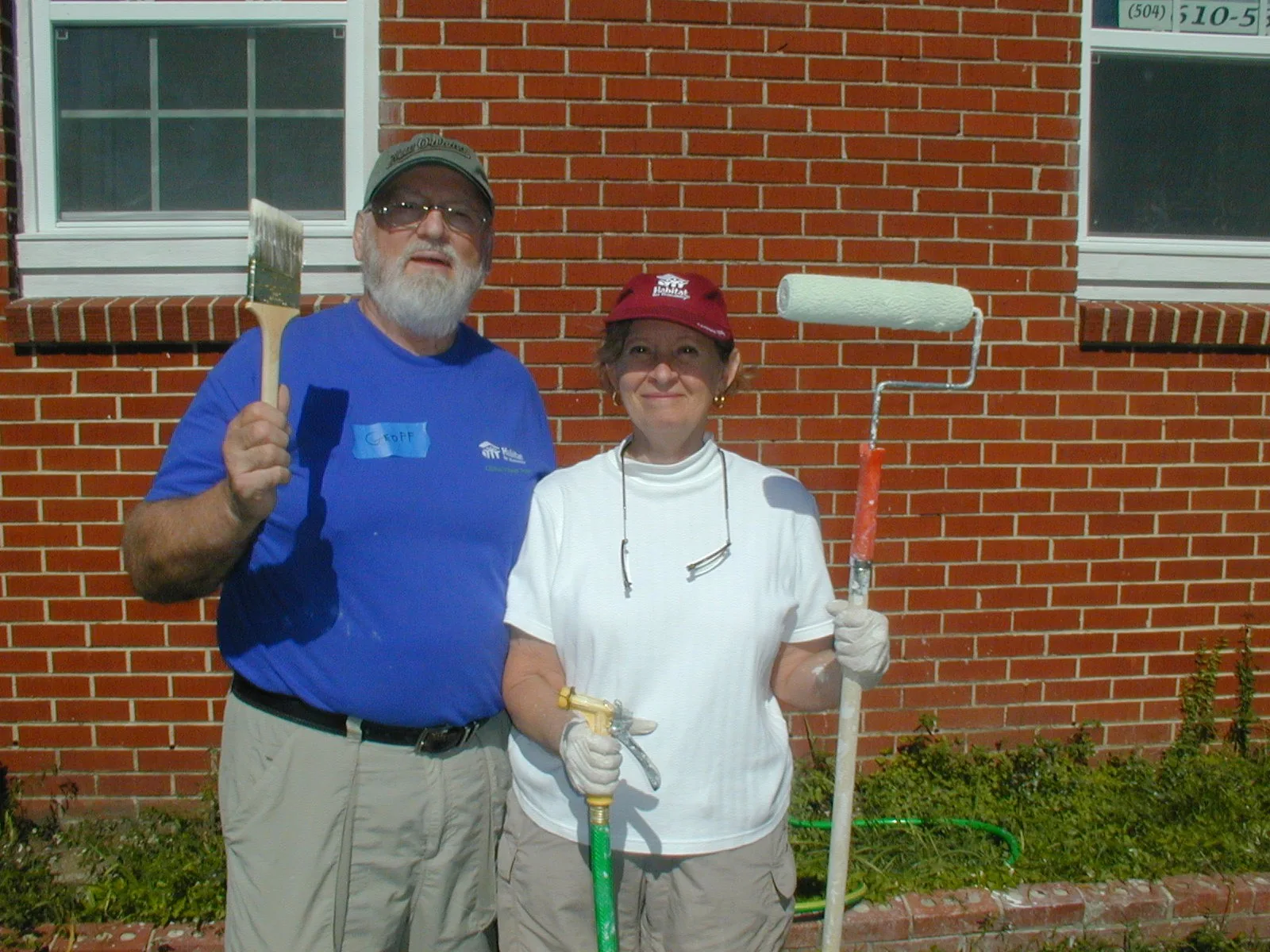
Our project house was located a few blocks south of Lake Pontchartrain. It belongs to a family that has been relocated to Little Rock, Arkansas, and wants to return to their home in New Orleans, but has essentially no funds to repair their house to a livable condition. During our week we painted the entire interior, two coats mostly, then prepared about a third of the floor space for ceramic tile and laid most of that tile. It was a pretty productive and rewarding experience for all, I believe. We were managed well by our handlers and could genuinely step back at the end of the week and say we made a difference.
Going to and from the jobsite each day, Stan Winarski piloted our SUV under the able guidance of Jill, who resided in a little GPS gizmo Stan mounted on the dash. Jill was wonderful. Every time we made a wrong turn (I think of the ten trips we made we went eight different ways) she would calmly and pleasantly say, “I’m recalculating.”
As John Lytle’s wife Karen, who has considerable experience in this field, explained to us, one of the many benefits of a mission trip is the forming and strengthening of the bonds of friendship, trust and cooperation amongst the missioners. This was very true of my experience and well worth the price of the ticket alone. I found, if you go for a 5:30 a.m. walk each day with a man, or share a drink at sunset on the veranda each day with a man, or hit a bar for the Va. Tech game with a man, they each become your friend. If you hold a floor tile whilst a man comes at you with a whirring grinder you learn to trust him. If a woman gives you a set of measurements which she has figured out herself to cut a complex piece of tile, and the tile fits just perfectly, you respect her for her intelligence. If a woman stoops to wash your bedding so you can go catch a plane, you raise her on a pedestal. If your entire mission group can clean up for dinner in an hour using five far-flung tiny hidden showers with no one getting embarrassed in the hallway, you’ve learned cooperation. And finally, you have learned forgiveness if someone you are working with makes a dumb mistake and you can just say with a smile, “I’m recalculating.”
Originally published in the Mission & Outreach Newsletter, December 2009/January 2010.