As we enter a new decade of worship at St. John’s it is interesting to look back through the centuries at the history of our parish. Our church began with the English settlement of the community which became Hampton. There is uncertainty, and no archaeological evidence, as to the location of the original site of a structure for worship.
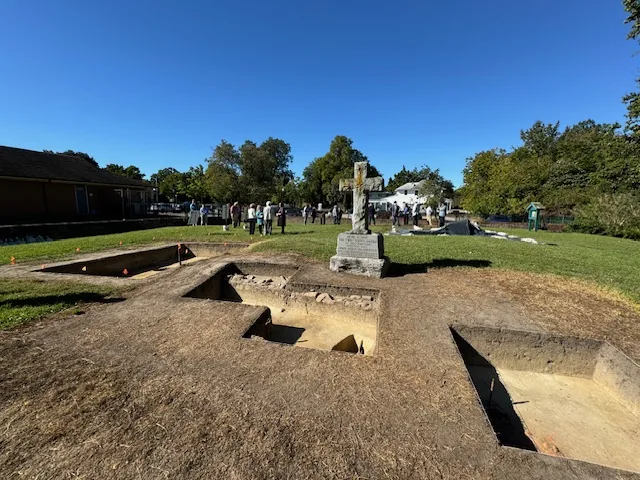
We do know a fair amount about the next location, or second site. A small wooden structure was built in 1623 on the east side of the Hampton River because the population of the settlement had shifted to this area. The building, which was approximately 23 by 52 feet, was wooden with a stone foundation, a covered entryway, and tile flooring.
Services, as today, followed the Book of Common Prayer, and there would have been a sermon and singing of psalms. The 1618 communion silver would have been used, as it was given to the parish in 1627. There was a social aspect to Sunday church attendance as well; the large number of pipe fragments on the site gives evidence that the settlers enjoyed gathering before and after services.
A destructive hurricane in 1667 and shifts in population to the west triggered a decision to relocate the church in that same year to the third site on present-day Pembroke Avenue. The second site church building remained standing and continued to be used on occasion for weddings and funerals until it was pulled down in 1698.
Archaeological excavations of the second site were carried out in the late 1960s and early 1970s under the auspices of the Association for the Preservation of Virginia Antiquities. Many of the artifacts from that dig are on display in the Church Museum in the Parish House. The second site is owned by St. John’s; it is located on the grounds of Hampton University and can be visited. To learn more, James Tormey’s history of our church, How Firm a Foundation, has a wealth of information.
Originally published in St. John’s Annual Report & Newsletter, February 2020.