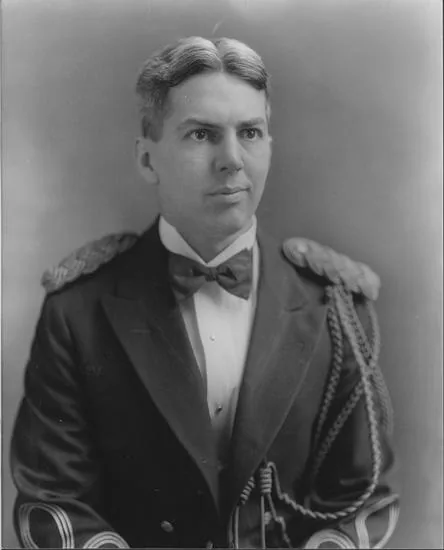
Lot 50
Once upon a time when there were such things, I was a paperboy. Every morning, I delivered 110 copies of the Daily Press to my neighbors in Wythe. Depending on the preference of the subscriber, I collected from them weekly, every other week, or monthly. Customarily on a Friday evening or Saturday morning, I called upon my customers, stood at their door or on their front porch, and collected what was due. However, there were a few customers who treated my visit as if I was a favored guest and would insist upon inviting me into their homes. They showed an interest in my life, listened to what I had to say, and, sometimes, offered me refreshments. General E. Sclater Montague and his wife, Suzanne (1905-1989), extended this type of a gracious welcome whenever I called upon them.
E. Sclater Montague wore many hats: prominent Hampton attorney, city council member, State Senator, delegate to two Virginia Constitutional Conventions, and General in the Virginia National Guard. I remember how proud he was to be a Hampton Crabber (class of 1914) and to have played on the state champion football team. During World War II, Montague served for a year and a half in the Pacific theater training Chinese officers.
Baptized by the Reverend John J. Gravatt on 2 June 1895, Montague was a lifelong member of St. John’s. For many years, he served as Senior Warden and was actively involved in the administration of the cemetery. Montague cherished his friendships with the rectors of our church. In fact, he wrote a monograph for the Syms-Eaton Museum titled, “St. John’s Church and the Ministers I Knew.”
Here are some of his observations:
“Dr. Gravatt was approximately six feet tall, rather heavy-set, clean shaven, and physically in many ways he resembled General Robert E. Lee.”
“On one occasion when returning with one of his nephews from Richmond on the C & O train, [The Reverend Carter Braxton Bryan] stood up from his seat in the day coach, raised his right arm high in the air and shouted, ‘Thank God for the Chickahominy!’ On the third occasion that he repeated this, his nephew said, ‘Uncle Brack, why do you say, “Thank God for the Chickahominy?”’ And, he said, ‘My boy, it kept the…Yankees out of Richmond for four years.’”
“[The Reverend Reverdy D. Estill] was not above dropping into a barroom on occasion and having a social drink with the boys, and as a testimonial of the high regard and respect of the saloonkeepers of the community for Dr. Estill, during the hour of his funeral every saloon in the city of Hampton voluntarily closed and hung black crepe over their entrance doors.”
“It was during the [Reverend Edwin R. Carter’s] rectorship that the prohibition movement in Virginia culminated in the 1914 election. This resulted in the closing of every saloon and the sale of whiskey prohibited in Virginia… The election was quite spirited in Hampton, and there was a definite division of sentiment among the congregation… [Prior] to the election, in almost every sermon, Dr. Carter emphasized the evils of whiskey and the virtues of abstinence. These remarks…resulted in considerable adverse criticism of the parson by a substantial minority.”
“On the occasion of the rehearsal for the wedding of my sister, Katherine Montague, my wife, Suzanne, was acting as the bride. Everyone was in a jovial mood, and something occurred which I have forgotten but it caused Suzanne to laugh, and thereupon the [Reverend Charles E. McAllister] convened all the bridal party before the altar and gave them a stiff lecture concerning the sacredness of marriage. Of course, anything critical of Suzanne is my ‘Achilles heel’. I managed to hold in my temper, but in that instance I was the closest I ever came to engaging in physical combat with a clergyman.”
“I estimate that the [Reverend George O. Watts] was about six feet four inches in height. He weighed around one hundred and ninety pounds. He had dark hair, walked with a slight stoop, and accented his words in the manner that Mr. Lincoln is reputed to have done. Up to that time, Mr. Watts was the closest friend I had among our clergymen.”
[The Reverend Theodore S. Will had his heart set on being elected Bishop at the 1938 Diocesan Council. However, there was no support for his candidacy and Bishop William A. Brown was selected.] “The Bishop’s election of 1938 had a tragic result for Mr. Will. It literally broke his heart. He was never the same again. Hour after hour and day after day he brooded over his loss of the election…I never saw him smile after the Petersburg Council. He accepted a call to Atlanta, Georgia at the first opportunity [and died within a year].”
“In the pulpit, [The Reverend Carter H. Harrison] had no peer. His sermons were interesting, profound and to some extent humorous. He had traveled widely though most of the world and he was personally almost as familiar with the geography of the ‘Holy Land’ as he was with…Hampton. During his rectorship in Hampton, our congregation raised a purse to send him again on a European tour.”
During the time in Virginia history when the Democratic machine of Senator Harry Byrd dominated state politics, Montague was an ardent and active supporter. In a twist, Montague’s son, David, served as the Republican Mayor of Hampton from 1971 to 1974.
Originally published in St. John’s Newsletter, October 2022.