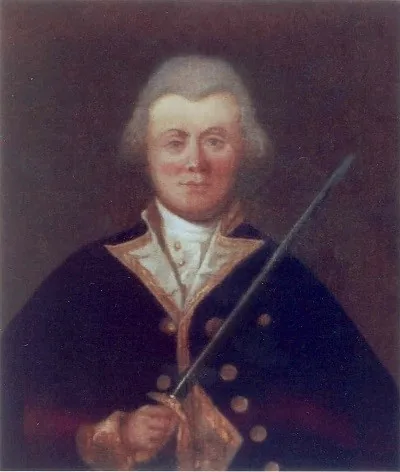
A rectangular stone tablet along the walkway from the south door of the church to Queensway identifies the burial site of Captain Henry Mowatt—a British naval officer. Today, in New England, Captain Mowatt is known, primarily, for the very successful brand of hot sauces that carry his name. During the American Revolution, New England loyalists looked to Mowatt for protection while patriots feared him for his brutality.
Born in Scotland in 1734, Mowatt went to sea at the age of 18. In the years just prior to the American Revolution, Mowatt sailed the coast of Maine for the British navy—surveying and capturing colonial merchant ships and their cargoes he suspected of smuggling. During the American Revolution, Mowatt received orders to “chastise” New England seaports. In his most infamous action, Mowatt directed the “Burning of Falmouth” (present-day Portland, Maine)—a 9-hour bombardment that destroyed the town on 18 October 1775. George Washington called Mowatt’s actions “an Outrage exceeding in Barbarity and Cruelty.”
In the years after the war, Mowatt continued his service in the royal navy. However, the object of his attention during these years was to do everything he could to disrupt French commerce and destroy French vessels. Off the coast of the Chesapeake Bay on 14 April 1798, Mowatt suffered a stroke and succumbed. Captain Mowatt’s remains were brought to our churchyard and buried.
Quoting from some marketing material from Captain Mowatt’s Hot Sauce Company: “Captain Mowatt bombarded the city of Portland in 1775. . . . Today, Captain Mowatt’s fiery fleet (of hot sauces) continue to burn the planet one tongue at a time.”
Originally published in St. John’s Newsletter, August 2021.