Lot 49
In the half-century after the Civil War, most Americans felt an urgent and profound desire for reconciliation. A nation, born in the spirit of sectional compromise, was bitterly divided by civil war when compromise was no longer possible on the vexing issue of slavery. Not surprisingly, many Americans found compromise to be a pathway to reconciliation in the post Civil War years.
One example of that compromise was the Lost Cause narrative. The Lost Cause interpretation of the war allowed Southerners to accept defeat with honor and allowed Northerners to be magnanimous in victory. While the Lost Cause narrative is much maligned today, it was tremendously successful in reuniting two formerly bitter foes and a nation weary of war.
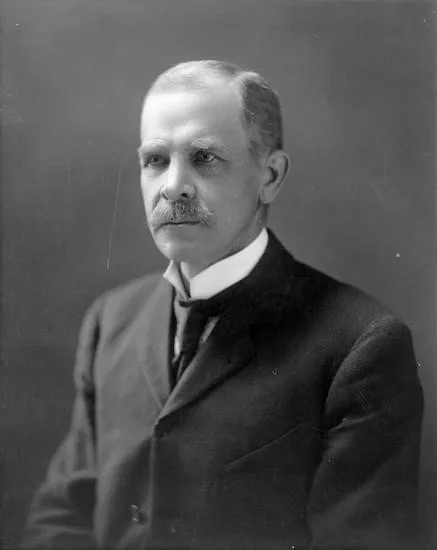
Jacob Heffelfinger was a symbol of reconciliation after the Civil War. Heffelfinger served with the 26th Pennsylvania infantry in General McClellan’s Peninsula Campaign of 1862. He fought in two major battles. He was wounded twice and captured twice. While convalescing at the Union Army hospital in Hampton, Heffelfinger went for a walk one day and found his army comrades camped around the walls of what was left of St. John’s after it was torched in August 1861 by Jefferson Curle Phillips, and other young men from Hampton, assigned to General John Bankhead Magruder’s command.
Jacob Heffelfinger, Union combat veteran, returned to Hampton in 1866 and never left. Wasting little time, he married a local woman, Louisa Whiting, and established what became a prosperous business—a lumber yard and building materials dealership on King Street (about where the Air and Space Museum is today). Heffelfinger was one of the first Hamptonians to have telephone service. In 1896, you could telephone him at his business by giving the operator his number—23.
Heffelfinger became a leading member of the community and an indispensable parishioner at St. John’s. Over fifty years, Heffelfinger served on the vestry, as treasurer and as superintendent of the Sunday School. Heffelfinger and his family are buried in Lot 49: Jacob (1840-1915), Louisa (1835-1923), two children who died in infancy, Elmer and Beverly, and a son, Louis (1878-1937).
In 1910, probably at his own expense, Jacob Heffelfinger wrote and published a history of St. John’s: Kecoughtan Old and New; or, Three Hundred Years of Elizabeth City Parish. Blowing the trumpet of reconciliation, Heffelfinger ended his magnum opus this way:
The word is said. I thank you for your patient hearing. I assure you that to me the preparation has been a work of love.
Will you here pardon a reference that may seem too personal, but while I hesitate, I cannot forebear?
For almost a half century, I have known these hallowed walls. Forty-eight years ago, next month, I limped across the bridge at the front of Queen street, an inmate of the federal hospital on the banks of the old Kecoughtan, a wounded boy soldier of McClellan’s army, fresh from the fields of the seven days conflict and the prison hospitals of Richmond. I sought some comrades of my own regiment whom I heard were in the locality. Wending my way along Queen street, through the ruins of the fire of ’61, I found the company for which I was looking bivouacing (sic) here in the shade of these old walls on the north side, directly under the Colonial Clergy Window; that was my first sight of Old St. John’s.
The walls stood as they now are, save that the gable of the west end had been crushed by the falling of the tower as a result of the fire.
Three years later, the war ended—I found myself a resident of the vicinity, and in the spring of 1866, I made my home in Hampton.
For the years 1866 to 1869, the ruins stood uncared for and my Sunday morning walks usually led me through these aisles, and among the surrounding tombs. It was my privilege to assist in the restoration of ’69 and ’70, and ever since this has been my church home, a home dear from many tender and hallowed associations.
Dear old Parish! Two baby boys repose in your God’s acre, and the mother of those boys, a born daughter of the Parish, still cheers and comforts me down the western slope of life.
Dear old Parish! Thy people are my people and thy God my God, here will I die and here will I be buried.
Dear old Parish! Today around thy Holy Table bow together the sons and the daughters of the first settlers, and the sons and the daughters of the red man, now returned from the far west to their fathers’ fields at Kecoughtan; sons and daughters of the soldiers who followed Washington, and the sons and daughters of the loyalists who clung to their king; and here bow together the gray hairs of those who followed Grant and those who fought under Lee—all receiving from the old cup and paten the emblem of the broken body and shed blood of the Captain of their Salvation, the Prince of Peace.
Dear old Parish! O go your way into the gate with thanksgiving and unto her courts with praise.
(Kecoughtan Old and New, pages 40-41: https://archive.org/details/kecoughtanoldnew00hef/page/40/mode/2up)
Originally published in St. John’s Newsletter, Midwinter 2022.